
Emotional Wellness & Self-Reflection
25 Journal Prompts to Help You Heal Emotionally After a Difficult Season
Gentle questions to help you understand what you feel, release what has been weighing on you, and begin moving forward with greater clarity, compassion, and hope.
Some seasons change us quietly. Others leave us feeling as though everything familiar has shifted at once. You may be carrying heartbreak, disappointment, grief, exhaustion, uncertainty, or the emotional weight of having stayed strong for too long.
During difficult times, it is not always easy to explain what you feel. Your thoughts may seem tangled, your emotions may change from one day to the next, and even a blank journal page can feel overwhelming.
That is where guided healing journal prompts can help. Instead of asking you to find the perfect words, a thoughtful prompt gives your emotions somewhere gentle to begin.
You do not have to understand your entire healing journey today. You only need enough honesty to take the next gentle step.
Why Journaling Can Feel Supportive During Difficult Times
Journaling gives you a private space to slow down and listen to yourself without interruption. Writing may help you name emotions, recognize thought patterns, explore what you need, and notice the strength you have already shown.
Your journal does not need to be polished or beautifully written. It does not need perfect grammar, complete sentences, or a positive conclusion. It only needs to be honest enough to meet you where you are.
Some days you may write several pages. Other days, one sentence may be enough. Both can be meaningful.

Before You Begin These Emotional Healing Journal Prompts
You do not need to answer all 25 prompts at once. Choose the question that feels most connected to what you are experiencing today. Set aside five to fifteen quiet minutes, take a slow breath, and write without trying to edit yourself.
You may also return to the same prompt more than once. Your answer can change as you gain clarity, experience new emotions, or begin to see your story differently.
Part One: Acknowledging What You Have Been Carrying
Healing often begins with giving yourself permission to admit what hurt, what changed, and what has felt difficult to hold.
What has this difficult season taken out of me?
Consider your energy, confidence, peace, relationships, routines, or sense of safety. Describe the effects without minimizing them.
What emotion have I been trying not to feel?
Name the emotion and explore what you fear might happen if you allow yourself to acknowledge it.
What part of my experience has been the hardest to explain?
Write what you wish someone could understand without requiring you to defend or simplify your feelings.
When did I realize I was no longer okay?
Reflect on the moment, pattern, or feeling that showed you something inside you needed care and attention.
What have I been pretending does not hurt anymore?
Give yourself permission to be truthful, even when the feeling seems inconvenient, complicated, or difficult to admit.
Part Two: Understanding Your Emotional Needs
Once you name what you are carrying, the next step is learning what your heart, mind, and body may need from you now.
What do I need today—not eventually, but today?
Your answer may be rest, reassurance, space, support, structure, honesty, nourishment, or permission to slow down.
Where do I feel this season in my body?
Notice tension, heaviness, restlessness, fatigue, or numbness. Describe what your body may be trying to communicate.
What would emotional safety look like for me right now?
Think about your environment, boundaries, relationships, daily routine, and the way you speak to yourself.
What am I tired of carrying alone?
Identify a burden you may be ready to share with someone you trust or address with additional support.
What boundary would protect my peace?
Consider where you may need to say no, step back, ask for clarity, limit access, or stop overexplaining yourself.

Part Three: Letting Go Without Dismissing Your Story
Letting go does not mean pretending something did not matter. It can mean choosing not to let the pain control every part of what comes next.
What am I holding onto because letting go feels frightening?
Explore what the pain, relationship, memory, or expectation may represent to you.
What am I blaming myself for that was not entirely mine to carry?
Separate what was within your control from what belonged to someone else, the circumstances, or information you did not have.
What expectation am I ready to release?
This may be an expectation about how life should have unfolded, how someone should have behaved, or where you thought you would be by now.
What would I say if I could speak without fear of the response?
Write an unsent letter. You do not need to deliver it for the words to help you understand what remains unspoken.
What deserves to stay in the past?
Identify a belief, habit, relationship dynamic, regret, or emotional responsibility you no longer want to bring forward.
Part Four: Rebuilding Trust in Yourself
Difficult seasons can make you question your decisions, worth, or ability to handle what comes next. These self-reflection prompts can help you reconnect with your inner strength.
How have I shown strength during this season?
Include quiet forms of strength such as asking for help, getting through the day, resting, trying again, or telling the truth.
What have I learned about myself through this experience?
Consider your needs, limits, values, courage, relationships, and what matters more clearly to you now.
What would trusting myself look like this week?
Choose one realistic action that demonstrates belief in your feelings, judgment, or ability to make a healthy decision.
What parts of me existed before this pain?
Remember your interests, dreams, personality, values, and the qualities that still belong to you.
What would I say to myself if I spoke with compassion?
Write as though you are comforting someone you deeply love who has experienced exactly what you have.
Part Five: Looking Forward With Hope
Hope does not require you to deny the hard parts. It gives you permission to believe that the hard parts will not be the only parts of your story.
What do I want the next chapter of my life to feel like?
Focus first on feelings such as peaceful, safe, joyful, grounded, connected, free, or hopeful—not only accomplishments.
What is one small thing I can look forward to?
Choose something close and reachable: a quiet morning, a walk, a conversation, a favorite meal, or a moment of rest.
Who am I becoming because I chose not to give up?
Describe the qualities being formed in you, even when your progress still feels incomplete.
What promise do I want to make to myself moving forward?
Keep the promise compassionate and realistic. It may involve honesty, rest, boundaries, support, patience, or self-respect.
What might healing make room for in my life?
Imagine what could grow in the space once occupied by fear, guilt, anger, confusion, or emotional exhaustion.
How to Create a Gentle Healing Journal Routine
Your routine should support you—not become another obligation. Begin with a rhythm that feels emotionally and practically sustainable.
-
1 Choose a calm moment.
Try writing in the morning, before bed, or during a quiet break. -
2 Begin with one honest sentence.
You do not need to fill an entire page for journaling to matter. -
3 Write without correcting yourself.
Let the page hold the thoughts before you decide what they mean. -
4 End with one compassionate thought.
Ask what you need or acknowledge one thing you handled well. -
5 Stop when you feel emotionally full.
You can return to the prompt another day. There is no need to force a breakthrough.
What to Do When Journaling Feels Too Difficult
Some prompts may bring up more emotion than you expected. You are allowed to pause, choose a different question, take a walk, breathe, or come back later.
You can also make the practice simpler. Write three words describing how you feel. Complete the sentence, “Today, I need…” Or make a list of what feels heavy and what feels supportive.
Journaling is not a test of how deeply you can explore pain. It is a tool that should remain respectful of your emotional capacity.

Continue Your Healing Journey
You Do Not Have to Face the Blank Page Alone
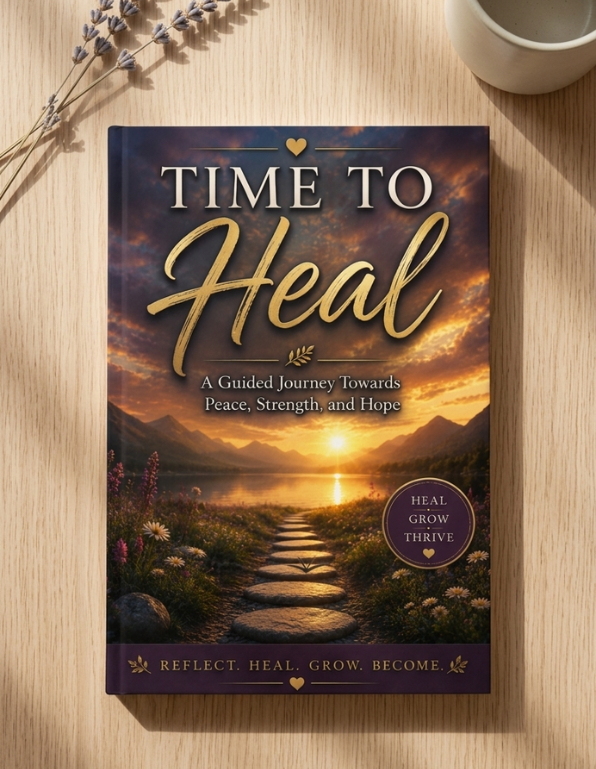
Time To Heal is a guided journal created to help you acknowledge the hurt, let go of emotional weight, rebuild your relationship with yourself, and move toward your next chapter with greater peace, strength, and hope.
Explore the Time To Heal JournalYour Healing Does Not Have to Be Rushed
Some days healing looks like a breakthrough. Other days it looks like resting, setting a boundary, asking for help, or choosing not to abandon yourself. Every honest step matters—even the quiet ones no one else can see.
This article is intended for general self-reflection and educational purposes. Journaling is not a replacement for professional mental health care. Consider speaking with a qualified professional when emotional distress feels intense, persistent, or difficult to manage on your own.